Why flight plan adherence matters
Johnny Pring, Manager for Policy and Advocacy at CANSO Europe, explains how disciplined flight plan execution can ease summer capacity constraints.
Summer 2025 – crowded skies, stretched capacity
The skies across Europe have been as busy as ever this summer as demand for air travel has continued to rise. According to EUROCONTROL, there was an average of 35,332 daily flights in the week of 4-10 August, which was four per cent more than the same week last year and three per cent up on 2019. In other words, traffic is back to pre-COVID levels – and in many countries it has already surpassed them.

Source: EUROCONTROL Flash Briefing Week 32 (4-10 August 2025) – Network Performance
European air navigation services providers (ANSPs) are working hard to provide the necessary airspace capacity to accommodate this growing traffic, but this is no easy task. European airspace is 20 per cent smaller since 2022 due to restrictions in place since the start of the Ukraine war. Moreover, many ANSPs had to postpone recruitment or training of air traffic control officers (ATCOs) during COVID and are still catching up. Adverse weather is also disrupting operations in certain locations and can have a knock-on effect across the network. Earlier this year, the European Network Manager launched a campaign aimed at all European aviation actors to set out what they can do to minimise delays during the summer travel season. One important but often overlooked measure within this, for both pilots and air traffic controllers, is flight plan adherence. Respecting this can contribute significantly to better use of the available capacity across the network, thus reducing delays.
What is flight plan adherence?
At least four hours before a scheduled flight departs, the pilot must submit an air traffic control flight plan to the responsible ANSP regarding the intended flight from the point of departure to its destination. Among the information provided, this must include estimated departure time, route, cruising speed, cruising level and total time.[1] In theory, this is the plan that the flight in question will follow, both vertically and laterally, in order to ensure safe separation from other aircraft. The submitted flight plans provide all the ANSPs across the network, as well as the European Network Manager, with a comprehensive view of the day’s traffic ahead of them so that they safely guide all flights to their destination.
In practice, the pilot may request a deviation from the flight plan once in the air. This is usually vertical but it could sometimes be a lateral one. Such a deviation could be for a number of reasons, such as weather or safety. It could also be because the pilot seeks a more advantageous route at short notice. It is then the decision of the responsible ATCO whether or not to allow this, and often it is granted, because they are very service-oriented and prefer to avoid time-consuming discussions with pilots. EUROCONTROL estimates that in June and July 2025, there was a daily average of 1,918 flights which vertically deviated their path into regulated airspace for non-weather reasons.[2]
Why does flight plan adherence matter?
Flight plan adherence matters because the impact of non-adherence can be felt well beyond the aircraft that requests the deviation. In the immediate term, there are three possible effects:
- Firstly, there is an unplanned entry into new airspace, which means that an ANSP has to find new capacity at short notice.
- Secondly, the aircraft is absent from the airspace which it had planned to use, which means lost capacity.
- Thirdly, a sudden sector overload can have implications for safety.
While an ATCO may allow such deviations based on the traffic situation at that moment in the airspace under their control, the knock-on effects can be felt across the European network. The aircraft may enter the adjoining airspace at a different flight level to the plan – this can increase the ATCO workload and be disruptive for the capacity available in that airspace. Subsequently, the responsible capacity manager may decide in the following days to accommodate less traffic on the basis that they may receive more unplanned entries.
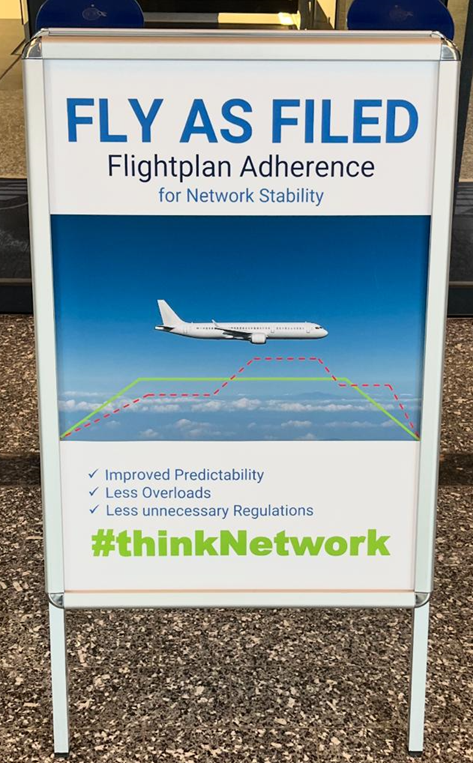
It is with good reason that EUROCONTROL named its summer 2025 preparation campaign #thinkNetwork in order to encourage all European aviation actors to view the impact of their actions beyond local level. It estimates that if pilots were to respect their flight plans other than for weather-related reasons, delays across the network could be reduced by 5-10 per cent.
EUROCONTROL data from early July shows that the worst affected area control centres for non-adherence are Zagreb (Croatia), Karlsruhe (Germany), Belgrade (Serbia), Bordeaux (France) and Budapest (Hungary). All of these airspaces have to cope with high traffic levels, often significantly more than was forecast a few years ago, and so the impact on capacity can be profound.
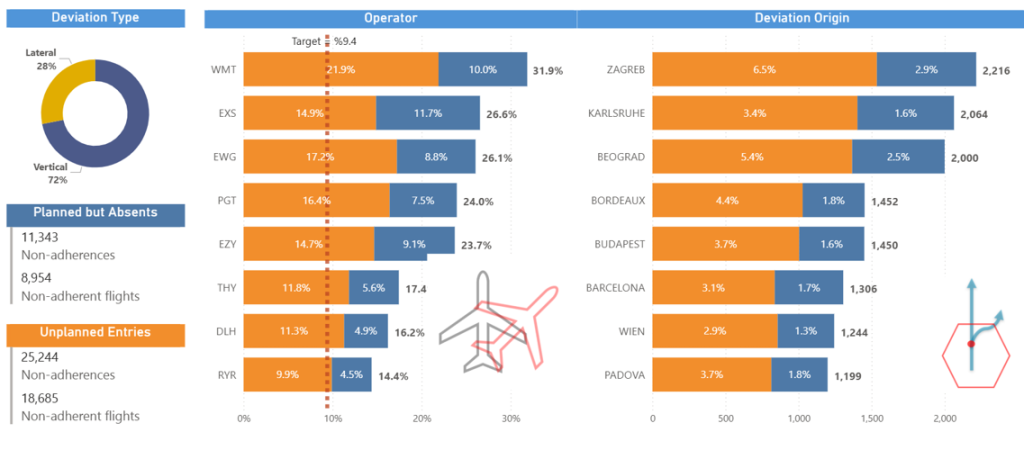
5-11 July Breakdown of Operators, Deviation Origin Airspaces and Their Deviation per Flight Source: EUROCONTROL Aviation Intelligence Unit
What can be done?
CANSO therefore calls for:
- ATCOs and pilots to apply the lessons of the EUROCONTROL #thinkNetwork campaign, which calls for pilots and ATCOs to fly as filed
- Airlines and ANSPs to support this with their own awareness campaigns so that all parties are aware of the negative consequences for the network of non-adherence to flight plans
- The Network Manager to avoid deviations in flight planning systems by not accepting flight plans which support non-adherence, e.g. for a 737 aircraft to fly at FL120
- EUROCONTROL to investigate deviations and produce further data in this area
- The Network Manager to discuss non-adherence on a bilateral basis with airlines and ANSPs, and ANSPs and airlines to discuss this bilaterally
[1] ICAO Annex 2: Rules of the Air
[2] EUROCONTROL ATM Network Operations Division, 12 August 2025