IATA WSOC Xiamen: Aligning industry to deliver future skies
The IATA World Safety & Operations Conference (WSOC), held in Xiamen, China, from 14–16 October, gathered more than 800 delegates from airlines, ANSPs, regulators, and technology partners under one roof. Over three days, participants explored strategies to future-proof aviation – building on decades of safety improvements while addressing a rapidly changing operational and technological landscape.
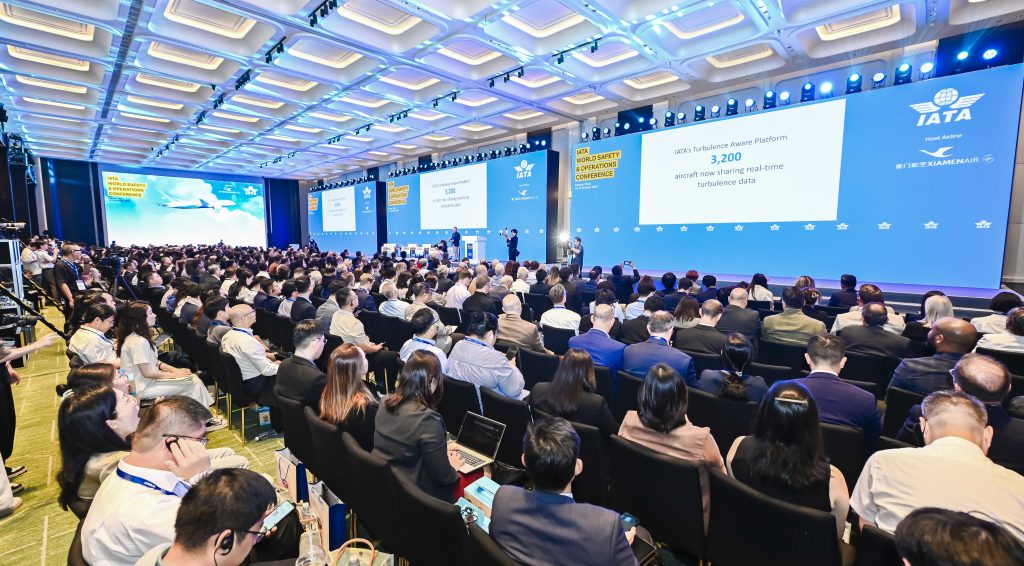
This year’s theme, “Future-proofing aviation: strategies for success,” placed particular emphasis on preparing for emerging risks. Evolving technologies, including artificial intelligence, were discussed not as distant possibilities but as tools to enhance resilience across the sector. Delegates tackled pressing issues such as lithium battery safety, GNSS interference near conflict zones, improving accident reporting, supply-chain pressures, and maintaining spectrum integrity amid growing telecom demands. The collective message was clear: by addressing these challenges today, the industry can meet tomorrow’s risks with confidence.
From foundations to innovation
Within this programme, Session 4: Airspace Management – From Foundation to Innovation, moderated by Cherif Ka (IATA), examined how airspace systems can evolve to handle growing traffic complexity. Speakers included Hermizan M. Jumari (CAAS), Captain James Toye (Cathay Pacific), and Eduardo García (CANSO).
The discussion reaffirmed core principles that must remain constant—safety leadership, trusted data, human accountability, and cross-border interoperability—even as innovation accelerates. Technologies such as Trajectory-Based Operations (TBO), dynamic sectorisation, and decision-support automation were identified as key enablers of more efficient, predictable, and sustainable airspace management.
CATS CONOPS in focus
CANSO’s Complete Air Traffic System (CATS) Concept of Operations featured prominently in the session as a practical framework for achieving this evolution. Centred on collaboration rather than competition, CATS outlines a seamless, digital, and scalable system designed to serve both traditional and emerging airspace users.
The CATS CONOPS enables data-driven and interoperable operations across borders, providing the foundation for advanced automation and TBO to deliver tangible performance improvements without compromising situational awareness or safety.
ICAO’s global opportunity
Speakers also reflected on the outcomes of the ICAO 42nd Assembly, particularly the decision to develop a minimum global implementation path for air navigation capabilities. This initiative was recognised as a major opportunity to reduce fragmentation and align progress internationally.
For organisations such as IATA and CANSO, it provides a clear mandate to translate global guidance into regional and operational results, supporting performance-based, interoperable solutions that can be scaled worldwide.
Innovation with purpose
The session emphasised that innovation must have a clear and measurable purpose. Artificial intelligence (AI) should first be applied in areas that directly enhance safety and efficiency—such as predictive analytics, traffic optimisation, and system health monitoring—while ensuring that human oversight and accountability remain central. The collective view was pragmatic: technology should strengthen human performance, not replace it.
Integrating new entrants
The integration of uncrewed aircraft, Advanced Air Mobility (AAM), and space operations was discussed as an operational reality rather than a distant goal. The conversation referenced the ICAO AAM Vision under development, which will provide a harmonised framework to guide States and industry through the gradual development of the AAM ecosystem.
Participants highlighted the need for demand-driven, dynamic airspace models capable of adapting in real time, underpinned by shared data, cross-border coordination, and standardised playbooks—particularly for launch and re-entry operations.
CANSO representation across WSOC
Beyond the airspace management session, CANSO contributed to two other high-level panels that reflected the organisation’s broad role in operational safety and innovation.
Spectrum and Air Navigation System Resilience
Moderated by Ruby Sayyed (IATA), this discussion explored how to safeguard aviation’s critical use of the radio frequency spectrum amid increasing interference from new telecom technologies such as 5G. Lisa Bee, Director Air Traffic Services at Viasat, represented CANSO’s Operational Standing Committee (OSC), highlighting how ANSPs and technology providers can collaborate with telecommunications stakeholders to maintain spectrum integrity and ensure the resilience of communication, navigation, and surveillance systems.
The Runway – Concentrator of Safety Actions
Moderated by Richard Allen-Williams (British Airways), this panel examined why the runway remains a key factor in the top accident categories of recent years. Representing CANSO’s Safety Standing Committee (SSC), Duangtawan Pinpimai (AeroThai) joined speakers from Delta Air Lines and Boeing to identify additional measures that could enhance runway safety. The panel reinforced the value of continuous safety data sharing and collaboration among operators, manufacturers, and service providers.
A united industry message
Across all WSOC sessions, a consistent message emerged: industry alignment is essential. The conversations in Xiamen demonstrated that future-proofing aviation is not simply about adopting new technology—it is about disciplined collaboration. By preserving the foundations, scaling what works, integrating new entrants with care, and moving forward in step through ICAO, the aviation community can deliver on its shared ambition: safer, smarter, and more sustainable skies.