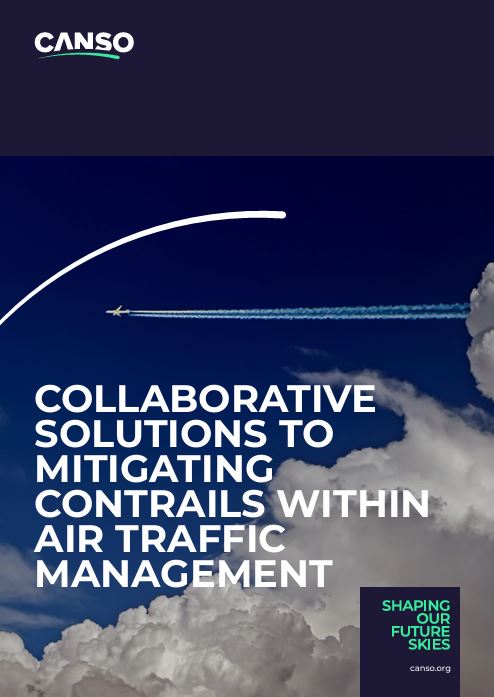
Collaborative Solutions to Mitigating Contrails Within Air Traffic Management
As the aviation industry works to reduce its carbon dioxide (CO₂) impact on the environment, aiming to achieve net zero by 2050, growing attention is being placed on the climate impact of non-CO₂ effects, particularly those caused by contrails.
Contrails, short for condensation trails, are cloud-like formations. These trails are composed of ice crystals that can evolve into persistent cirrus clouds, trapping outgoing longwave radiation, and thus contributing to atmospheric warming. Though less persistent than CO₂, contrails, particularly those forming in Ice Supersaturated Regions (ISSRs), can have a comparable or greater near-term climate forcing effect. While carbon dioxide emissions have long been the focus of climate mitigation efforts due to their longevity in the atmosphere, the short-lived but potent warming effects of contrails are now receiving increased attention.
This paper explores the current state of science and mitigation strategies surrounding contrail formation, with emphasis on potential strategies for
multi-stakeholder, collaborative ATM approaches. The operational, economic, and regulatory challenges aswell as the climate impact of proposed strategies will be discussed.
This paper introduces the key stakeholders involved and outlines the main drivers behind the need for a shared mitigation approach. These drivers provide a foundation that enables proposed strategies and solutions to be assessed within a collaborative framework. Any potential contrail mitigation strategies should be tested by this reasoning to explain how this approach can benefit all stakeholders.